Spanish
What is the Colosseum made of

The bulk of the Colosseum’s foundational structure was built using concrete and tuff, a type of volcanic rock. Roman concrete, also known as opus caementicium, was a revolutionary material during the time when the Colosseum was built. Unlike modern concrete, which is composed of cement and aggregate, Roman concrete was made using a blend of volcanic ash, lime, and seawater, which created a mixture that could set underwater. The Romans were the first civilization to use this versatile, sturdy material on a large scale, using it in various monumental structures, including the Colosseum.
Tuff, the other primary building block, is a light, porous rock formed by the consolidation of volcanic ash. This was abundantly available around Rome and was utilized for the inner walls and vaults of the Colosseum. It is worth noting that although tuff was lighter than other stone materials, it was sufficiently strong to support the massive loads of the structure, thus contributing significantly to its resilience and longevity.
Table of Contents
ToggleExterior Materials
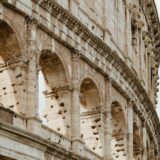
The exterior of the Colosseum was encased in travertine, a form of limestone transported from quarries in Tivoli, about 20 miles away from Rome. Travertine was used for the piers and arcades, and held together by 300 tons of iron clamps, giving the amphitheater its gleaming, magnificent facade. Travertine’s durability, resistance to weathering, and ease of carving made it the perfect choice for the external structure and decorative elements. It is estimated over 100,000 cubic meters of Travertine was used.
Interior Materials
Inside, the Romans used marble, a symbol of luxury and opulence, extensively for decorative purposes. The spectators’ seats were made of marble, with different grades of marble indicating different seating levels and social classes. The wealthier and more prestigious individuals sat closer to the action on high-grade marble seats, while those of lower social status were farther away.
In its heyday, the Colosseum boasted a labyrinth of underground passages and rooms, known as the hypogeum. This complex network was primarily constructed using brick-faced concrete. The Romans also incorporated wooden structures, like lifts and trapdoors, which were used to bring animals and gladiators to the arena floor.
Final note
In conclusion, the Colosseum’s rich tapestry of materials, comprising of concrete, tuff, travertine, marble, and wood, all carefully chosen for their unique characteristics, demonstrate the Romans’ architectural finesse and their knowledge of material properties.